Archive | leadership RSS feed for this section

Successful Leaders Don’t Focus on All the Details

4 Sep

What if a leader’s job is to look at most things out of focus?Leaders Don't Focus on All the Details

Typically, we think leaders should have a strong vision, focus on that vision, and help others focus on that vision.

But what if a leader’s job is to keep most things slightly out of focus?

When we hear words like micromanagement, isn’t that an indication that the particular leader doing the micromanagement has gotten too focused on some particular details of the organization? This leader would better serve the organization by bringing a situation slightly more into focus but not making it crystal clear. She or he should keep most things at an arm’s length, slightly out of focus.

This does not mean that someone else in the organization shouldn’t be focused or even hyper-focused on any particular situation’s details. This is why you have many people serving in different roles in the organization. Everyone is paying attention to different details.

Key Differences between Successful and Unsuccessful Leaders

But leaders need to separate the details important to them from all the rest. Leaders need to become comfortable with letting others manage details in areas out of the leader’s focus.

I suspect this is a key difference between successful and unsuccessful leaders. Successful leaders focus on only the most important details and let others manage the rest. Successful leaders have mastered the art of being comfortable with viewing many parts of the organization slightly out of focus.

Management Philosophy: Things I Don’t Believe

6 Jun

My management philosophy?Management Philosophy- Things I DON't Believe
Here are some things I don’t believe:

I don’t believe in productivity, whether it’s demanding it or measuring it.

I don’t believe in yearly evaluations.

I don’t believe in excuses.

I don’t believe that people prepare well enough for most meetings and I don’t believe that most people treat meetings as if they are important.

I don’t believe in treating customers better than employees or providing better customer service to customers than employees.

I don’t believe that every meeting needs to stick to the exact agenda, especially if that becomes an easy way to avoid conflict or tough questions.

I don’t believe in skill sets.

I definitely don’t believe in skill sets.

I don’t believe age is an indicator of ability.

I don’t believe experience is necessary (though often helpful).

I don’t believe in hiding facts.

I don’t believe in ignoring facts.

I don’t believe that one person’s facts are enough to conclude the truth of the matter.

I don’t believe 100% is ever attainable, thus I don’t believe in launching when things are 100% ready.

I don’t believe in striving for less than 100%.

I don’t believe in management philosophies.

What don’t you believe?

The Wisdom of Not Knowing

17 Feb

What does knowing bring us?The Wisdom of Not Knowing

It often brings us comfort. We think that knowing gives us power, control, even wisdom.

But knowing is a false state of mind because what we know pales in comparison to what we don’t know.

What we don’t know is what makes life interesting. What we don’t know, especially about others, is what necessitates empathy.

The opinions we form based on what we know should forever change based on what we find out we didn’t know.

This is why we often think of God as infinite wisdom, this ability to know everything.

And yet we act as God, thinking that our limited knowledge gives us space to create absolutes.

Instead, we should live open, open to the unknown, open to the expansion of our knowledge.

This openness gives rise to wisdom. Not a wisdom of knowing everything, but a wisdom found in being open to living.

Be wise.
Be open.
Be alive.

Vision Creation Theory of Leadership

9 Feb
Vision Creation Theory of Leadership

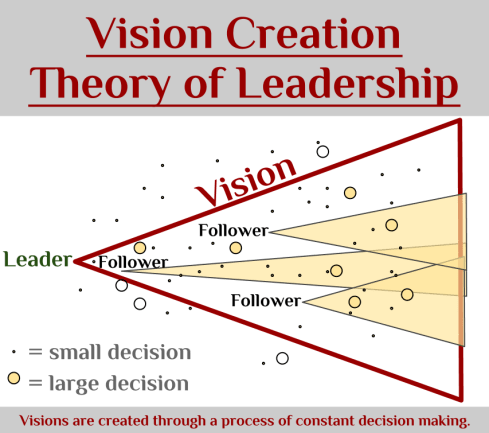
Visions are created through a process of constant decision-making.

Leadership is often made synonymous with vision creation. Strong leaders are assumed to have a strong vision. But I don’t think that is quite right. Leaders may have strong boundaries on their vision, but that doesn’t mean they hold every detail in focus. Instead, strong leaders know they must trust the people carrying out the vision. They must trust these people because only through them is every detail attended to.

Leaders should focus on making the best decisions on questions within the scope of the vision they have broadly defined. This is an essential task of leadership: to determine what questions are within the realm of the vision. This doesn’t mean that leaders will answer every question. No, instead, they will rely on others with more knowledge of the details to make decisions.

How Many Decisions Do We Make Each Day?

How many decisions does a person make in each day? We make at least 200 food decisions alone every day, on top of the thousands of other decisions. These daily decisions create the story of our life, whether we realize it or not.

So what about organizations? How many decisions does an organization make each day? If we assume 1,000 decisions per person per day and assume that maybe 1/3 of those decisions are work related (probably more), then we could take the number of employees times 333. For an organization of 100 people that would be over 33,000 decisions each day! No leader could handle making that many decisions. It is  obviously not realistic, desired, nor would it be productive.

Employees make thousands of decisions each day without the oversight of a leader. So how does vision creation work in this context?

Vision Creation Theory Diagram

This simple illustration gives an idea of how visions are created through leadership and the decision making processes.
Vision Creation Theory of Leadership

Though obviously more complex, decisions are broken into small and large decisions. Small decisions happen all the time and may or may not help better define the vision. Choosing which color pen to use will not affect the vision.

On the other hand, there are many other daily decisions that will affect the vision. Employees will handle many of these questions themselves. But there will be decisions that need more thought and this is where leaders often step in.

Six Key Roles of a Leader in the Vision Creation Process

Here are the roles of the leader in this model of vision creation. Leaders:

  1. Help create and refine the vision.
  2. Keep the scope of the vision in balance.
  3. Determine whether or not a decision is within the scope of the vision.
  4. Make decisions or give space to make decisions on important questions that the define the vision and scope of the vision.
  5. Listen – this topic is so important it warrants its own bullet points.
    1. Leaders listen to bring pieces of the vision into focus. Leaders also listen to help individuals place their contributions into the broader context of the vision.
    2. Leaders listen to better understand why the vision and pieces of the vision matter to people.
    3. Leaders listen to let other know that their participation and work within the vision matters.
  6. Delegate decisions to others so that the vision creation process is participatory and so that they can focus on only the most important decisions defining the vision.

None of this is to say that decisions that aren’t made by leaders are not important. Instead, I am suggesting that a leader’s most important work revolves around the constant vision creation process and the decision-making process used to get there.

What decisions have you made today? What visions are you creating?

What Is a Persistent Optimizer?

15 Oct

What Is a Persistent Optimizer?

Once I get a big question in my head, it doesn’t leave. I will drive in to work thinking about insights and answers, spend all day working on solutions, drive home thinking, and then spend my most productive evening hours working on solutions. I will read voraciously the best material I can find about the issue. I will find the experts on the issue, talk to them, and read what they have to say. I will start to zoom in on the large themes and connections I see and develop my own unique response to the question or problem at hand. Though intense, this is fun for me! Finding big answers to big questions is where I gain the most energy.

Persistent Optimization – A Story

In 2007, six months into my current job, I saw that our manual CRM and registration system was not adequate for the future. I saw the trend that people were going to increasingly register and purchase goods and services online. I spent an extra 100 hours outside of my normal work hours in the month of January 2007 analyzing our customer and staff needs, researching potential options, talking to experts, and eventually designing and developing a custom registration and CRM application, from scratch. This was a big and complex problem that was quite fun to solve. We went from 0% online registration to 70% in just one year. We increased our attendance over 30% in the next five years. I estimate that we saved 4-8% in personnel costs, and we drove our mailing costs down to $0 through the use of automated emails and CRM communication functions.

My Strengths

Deep understanding of how to bring value to an organization

I seek out root causes and hate to see surface solutions stall the discovery of root change. I also love data because it gives one important piece of the puzzle when determining whether or not some solution is successful. Data helps you focus on the right things. I know that value is best-measured with supporting data. I bring the highest value to any work because I revel in measuring the details. I design and implement human performance solutions and systems that solve root issues.

Focus on human performance and solutions

I pursued and completed graduate studies in leadership not to simply lead but to discover ways to allow people to perform at their highest levels. I discovered early on in my teaching career that the social and emotional  dimensions of people’s lives are just as important as the cognitive and pyschomotor components. I work to bring good change to people and organizations.

Instinctive ability to work at the highest level

I also love to learn myself and pursue topics of interest as deeply as possible. I am well read across diverse disciplines and am able to walk into any given organization and discern issues and areas of opportunity very quickly, by both observing processes in motion and by talking with leaders, workers, and customers. People want to work with me because they know I am trustworthy and support their success.

What is Organizational Leadership?

15 Oct

I completed a Master of Science degree in organizational leadership in 2011. I have been asked more than a few times, “What is your degree in?” I found that many elements distinguished my experience and I wanted to share what this study of leadership really meant to me.

The organizational leadership program focused a great deal on ethics. This was a program to learn not just to lead, but to lead in a way that was good, just, and right. These are lofty ideals, yes, but have an urgent importance. Organizational cultures are created by big decisions and influential events, but they are also created by the decisions people make all day, every day.

“Our Small Decisions as Leaders Have Great Effect on the Future”

Our job as leaders is to be conscious of the effect both our large and seemingly small decisions have on the people around us and the organizations we lead. It is easy to forget that today’s decision has effects far into the future. Double this with the short-term success pressures one often faces and it is even harder to make the right decision for long-term success.

One thing leaders can do to combat these pressures is to recognize their own tendencies, personality traits, and needs. What we do under pressure can be very different than what we might do in a less intense situation. Knowing what literally gets our blood boiling is very helpful. Recognizing the potential for a situation to upset us and bring out our fallback responses allows us to prepare better to make better decisions that reflect our better selves.

I also learned that leaders must recognize the strengths, weaknesses, and needs of those they lead. The situational leadership theory we studied was one of my favorite theories and suggested we give a great deal of attention to those we lead. We increase our reach as a leader by empowering others to do great work.

I covered these topics at various levels of detail and through various disciplines within the organizational leadership program. The program gave me the experience of looking critically at myself and reflecting on the decisions I make every day. It enabled me to recognize the important ways leaders affect those around them and how that affect helps bring success or failure.

See also, “The Three Leadership Essentials I’ve Learned”.

Persistent Optimizer, Tech Guy, Great Manager and Coworker, Won’t Rest Until Your Problems Are Solved

3 Oct

Michael E. Roman, M.S.

Email: michael.e.roman@gmail.com | Phone: 513-685-0689

Professional Summary

A senior director with over two decades of experience who uses data to translate ambitious strategy into flawless execution. Grew a complex business unit by 68% to $42M+ with full P&L ownership, scaling the team from 200 to over 400 members while consistently exceeding financial targets. Combines a persistent optimizer’s mindset with deep financial expertise and applied data science to build the teams and systems that deliver sustainable growth.

PROFESSIONAL EXPERIENCE

Cincinnati Children’s Hospital Medical Center (CCHMC), Cincinnati, OH

Senior Business Director, Behavioral Medicine and Clinical Psychology (2019 – Current)

  • P&L Management & Strategic Growth: Directed the complete financial and operational growth of one the largest division in the Research Foundation at CCHMC, driving 68% revenue growth ($25M to $42M) and scaling the organization by 90% (214 to 406 FTEs) in five years.
  • Financial Performance: Held full P&L responsibility for a $42M+ operating budget, exceeding margin targets for four consecutive fiscal years (FY20-FY23) through rigorous financial planning, forecasting, and variance analysis.
  • Operational Scaling & Service Delivery: Scaled clinical service delivery by 44% from 2019 to 2024, overseeing operations for 145+ providers across 10+ locations, resulting in 152,000+ annual client engagements.
  • Executive Leadership & Talent Management: Provided strategic direction for a complex, 400+ member division encompassing clinical, research, and educational verticals, including 80+ faculty, 90+ clinical providers, and 40+ business and support staff.
  • R&D Portfolio Management: Directed the full lifecycle of a $20M+ R&D grant portfolio, overseeing pre-award and post-award financial activities for 65+ federal grants and contracts to fuel institutional innovation.
  • Data & Analytics Leadership: Led data analytics, technology, and project management teams to drive business intelligence. Championed a culture of continuous improvement through Quality Improvement (QI) initiatives and business process automation.
  • Capital & Infrastructure Planning: Managed capital expenditure planning for all divisional real estate projects, including building renovations and the strategic expansion of the satellite location footprint.
  • Institutional Strategy: Contributed to institutional financial strategy as an active member of the Cincinnati Children’s Research Foundation Finance Committee and served as a Workday Ambassador to drive enterprise-wide technology adoption.

Business Manager, Behavioral Medicine and Clinical Psychology (2017 – 2019)

  • Managed a $12M research P&L, providing financial oversight for 25+ research faculty and 50+ staff.
  • Designed and deployed a scalable Business Intelligence (BI) tool (“Investment in Research” report) to automate financial reporting; successfully trained and onboarded 20+ divisions to the new platform.

Financial Analyst I/II & Grant Specialist, Emergency Medicine (2013 – 2017)

  • Managed a $4.5M+ research budget, including financial analysis, monitoring, and management for over 35 grant accounts.
  • Co-developed a BI dashboard for executive leadership to monitor real-time research performance metrics against strategic goals.
  • Managed the full project lifecycle for the redevelopment of a custom research application for tracking participant enrollment and effort.
  • Recognized as a subject matter expert; selected to present on internal communications strategy at the 2014 Grant Professionals Association Annual Conference.

Gorman Heritage Farm Foundation, Cincinnati, OH

Program Director (2007 – 2013)

  • Revenue Growth & Go-to-Market Strategy: Achieved 80% revenue growth in four years by developing and executing a data-driven customer personalization strategy based on in-depth market analysis.
  • Business Development: Secured $128K+ in new funding through grant writing and administration, contributing 5% of the total organizational budget for three consecutive years and increasing program support by 20% through targeted donor engagement.
  • Technology & Process Improvement: Engineered and implemented a custom Customer Relationship Management (CRM) application to manage a 70%+ online registration pipeline. Built and maintained the department’s intranet to streamline employee and volunteer onboarding.
  • Talent Management: Led talent acquisition, training, and management for a 15-person team, achieving a 95%+ customer satisfaction rating.

CONSULTING EXPERIENCE

Farm-Based Education Association (FBEA), (virtual) Concord, MA

Web, Social Media, and Communications Strategist (2009 – 2014)

  • Drove 200%+ user growth for a national online membership community within two years by developing and executing strategic digital engagement initiatives.
  • Served on the FBEA’s Communications Committee, advising on national conference planning and long-term digital communication strategies.

EDUCATION & CERTIFICATIONS

Massachusetts Institute of Technology (MIT) Professional Certificate: Applied Data Science – Leveraging AI for Effective Decision-Making

Mount St. Joseph University Master of Science in Organizational Leadership – Summa Cum Laude

Xavier University Bachelor of Arts in Music – Cum Laude